Community led Research
Abstract
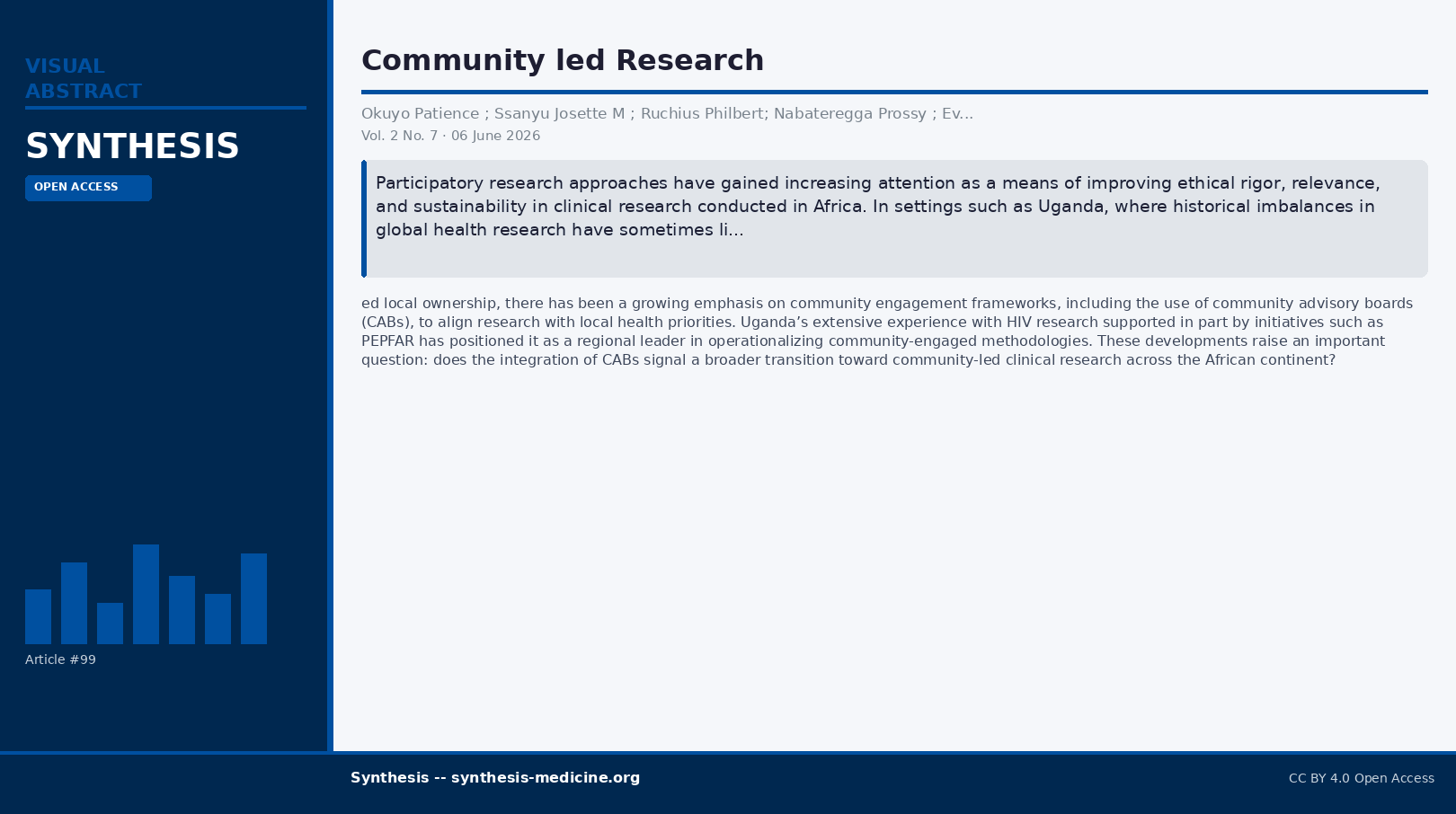
Participatory research approaches have gained increasing attention as a means of improving ethical rigor, relevance, and sustainability in clinical research conducted in Africa. In settings such as Uganda, where historical imbalances in global health research have sometimes limited local ownership, there has been a growing emphasis on community engagement frameworks, including the use of community advisory boards (CABs), to align research with local health priorities. Uganda’s extensive experience with HIV research supported in part by initiatives such as PEPFAR has positioned it as a regional leader in operationalizing community-engaged methodologies. These developments raise an important question: does the integration of CABs signal a broader transition toward community-led clinical research across the African continent?
References
Barugahare, J., & Kass, N. E. (2022). Managing community engagement in research in Uganda: insights from practices in HIV/AIDS research. BMC medical ethics, 23(1), 59. https://doi.org/10.1186/s12910-022-00797-6
Pancras, G., Sunguya, B. F., Sirili, N., Balandya, E., Lyamuya, E., & Mmbaga, B. T. (2022). The role of community advisory boards in community-based HIV clinical trials: a qualitative study from Tanzania. BMC medical ethics, 23(1), 1. https://doi.org/10.1186/s12910-021-00737-w
Ganjeh, Y., Ngaruiya, C., Albee, B., Funaro, M. C., Bongomin, F., Vergara Greeno, R., Bothwell, L., & Ebbs, D. (2025). Community Based Participatory Research in Global Health: Time to Provide Appropriate Ethics Training for Community Researchers. Inquiry : a journal of medical care organization, provision and financing, 62, 469580251350492. https://doi.org/10.1177/00469580251350492
Published
Versions
- 2026-06-16 (2)
- 2026-06-06 (1)
Issue
Section
License
Copyright (c) 2026 OKUYO PATIENCE, Ssanyu Josette M, Ruchius Philbert, Nabateregga Prossy, Evelyn Nakuya, Kindiki Agnes

This work is licensed under a Creative Commons Attribution 4.0 International License.
Articles in Synthesis are published under the Creative Commons Attribution 4.0 International (CC BY 4.0) licence. Authors retain copyright.