The Country Anatomy of CT.gov Transparency Gaps: A Fourteen-Lens Audit of 249,507 Older Closed Interventional Studies
Abstract
ClinicalTrials.gov hosts the world's largest public registry of clinical research, yet a substantial share of older closed studies remain silent — posting no results, no linked publications, and no endpoint descriptions. Whether this silence is geographically structured, and in what ways, remains poorly characterised. We conducted fourteen pre-specified analyses of 249,507 eligible older closed interventional studies drawn from the March 29, 2026 full-registry snapshot, measuring country-linked transparency across nine distinct gap dimensions: ancient backlog, description black-box, detailed-description gap, enrollment gap, composite excess watchlist, ghost-protocol excess, narrative gap, overdue debt, primary-only gap, primary-outcome gap, country-linked sponsor concentration, text asymmetry, and U.S.-versus-ex-U.S. sponsor-class stratification. The United States dominated absolute stock tables on every dimension by virtue of registry scale; rate tables revealed a different and smaller group of countries — Iran, Japan, France, South Korea, Egypt, Norway, Slovakia — each leading on different gap dimensions. The most policy-salient finding was the jurisdictional divide: studies involving at least one U.S. site carried a 52.1% no-results rate versus 88.7% for studies with no U.S. involvement, a 36.7-percentage-point gap consistent with the regulatory reach of the FDA Amendments Act. Disease and geography interact non-additively: oncology studies involving China reached 79.0% no results versus 52.6% for those involving the United States, and cardiovascular studies involving Egypt reached 95.9%. No single country or metric captures the problem; the geography of transparency failure is multidimensional.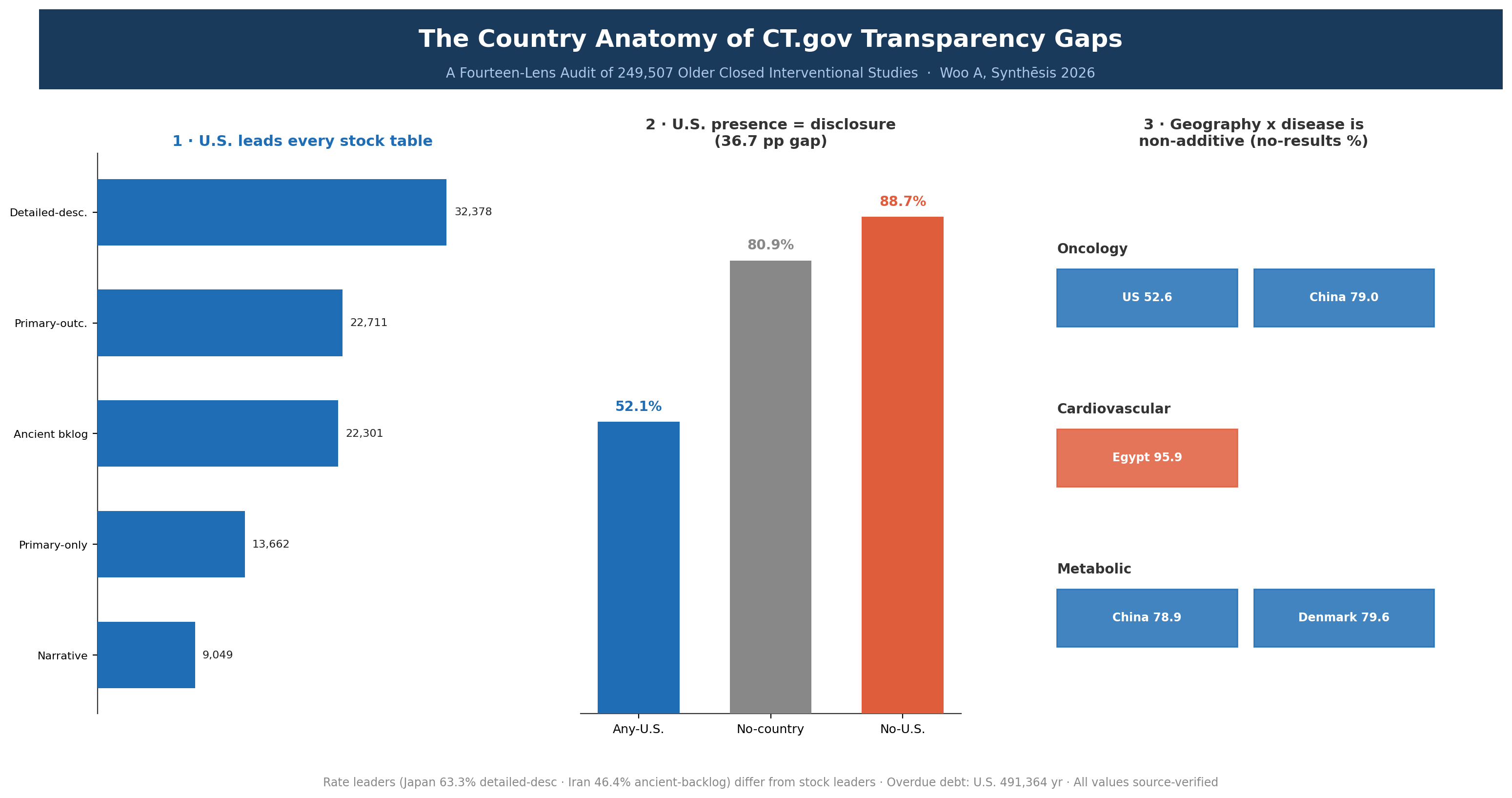
Published
2026-07-02
Issue
Section
Research Article
License
Copyright (c) 2026 The Author(s)

This work is licensed under a Creative Commons Attribution 4.0 International License.
Articles in Synthesis are published under the Creative Commons Attribution 4.0 International (CC BY 4.0) licence. Authors retain copyright.
How to Cite
The Country Anatomy of CT.gov Transparency Gaps: A Fourteen-Lens Audit of 249,507 Older Closed Interventional Studies. (2026). Synthesis, 2(7). https://synthesis-medicine.org/index.php/journal/article/view/176