The Disease-Family Anatomy of CT.gov Transparency: Eleven Condition-Stratified Dimensions across 249,507 Older Closed Interventional Studies
Abstract
Background: CT.gov transparency has been reviewed at the registry level. It remains unclear how opacity is distributed across therapeutic areas, and whether different types of silence cluster differently by condition family. We decompose transparency using eleven condition-stratified dimensions. Methods: We analysed 249,507 eligible older closed interventional studies from the 29 March 2026 ClinicalTrials.gov snapshot, assigning each study one condition-family label. We assessed eleven dimensions: (1) ancient backlog, (2) detailed-description gap, (3) enrollment gap, (4) excess no-results stock, (5) excess ghost stock, (6) narrative gap, (7) overdue debt, (8) primary-only gap, (9) primary-outcome gap, (10) sponsor repeaters, and (11) text asymmetry. We also conducted a geography sub-analysis. Results: Two distinct silence patterns emerged. Oncology and cardiovascular dominate absolute counts: oncology contributed 11,369 ancient-backlog studies, 255,229 cumulative overdue years (9.0 years per study), and 11,207 primary-outcome gaps; cardiovascular contributed 6,545 ancient-backlog studies, 154,672 overdue years, and 7,006 primary-outcome gaps. Healthy volunteers showed the opposite pattern — higher rates: 50.2% description gap, 35.0% primary-outcome gap, 31.5% ancient-backlog rate, 22.0% narrative gap, and 1,032 excess ghost protocols above expectation (versus below-expectation ghost counts for oncology and cardiovascular). Geography amplified these differences: non-U.S. studies showed 86.8–90.3% no-results rates, compared with 29.4–39.4% for mixed-geography studies in the same disease families. Sponsor-level pockets were invisible in registry-wide tables: the National Cancer Institute held 909 oncology no-results studies, Assistance Publique–Hôpitaux de Paris reached 100.0% no-results in cardiovascular, and Novo Nordisk carried 391 metabolic no-results studies. Conclusions: CT.gov silence is structurally patterned by condition family; accountability requires condition-stratified, geography-disaggregated, and sponsor-resolved metrics.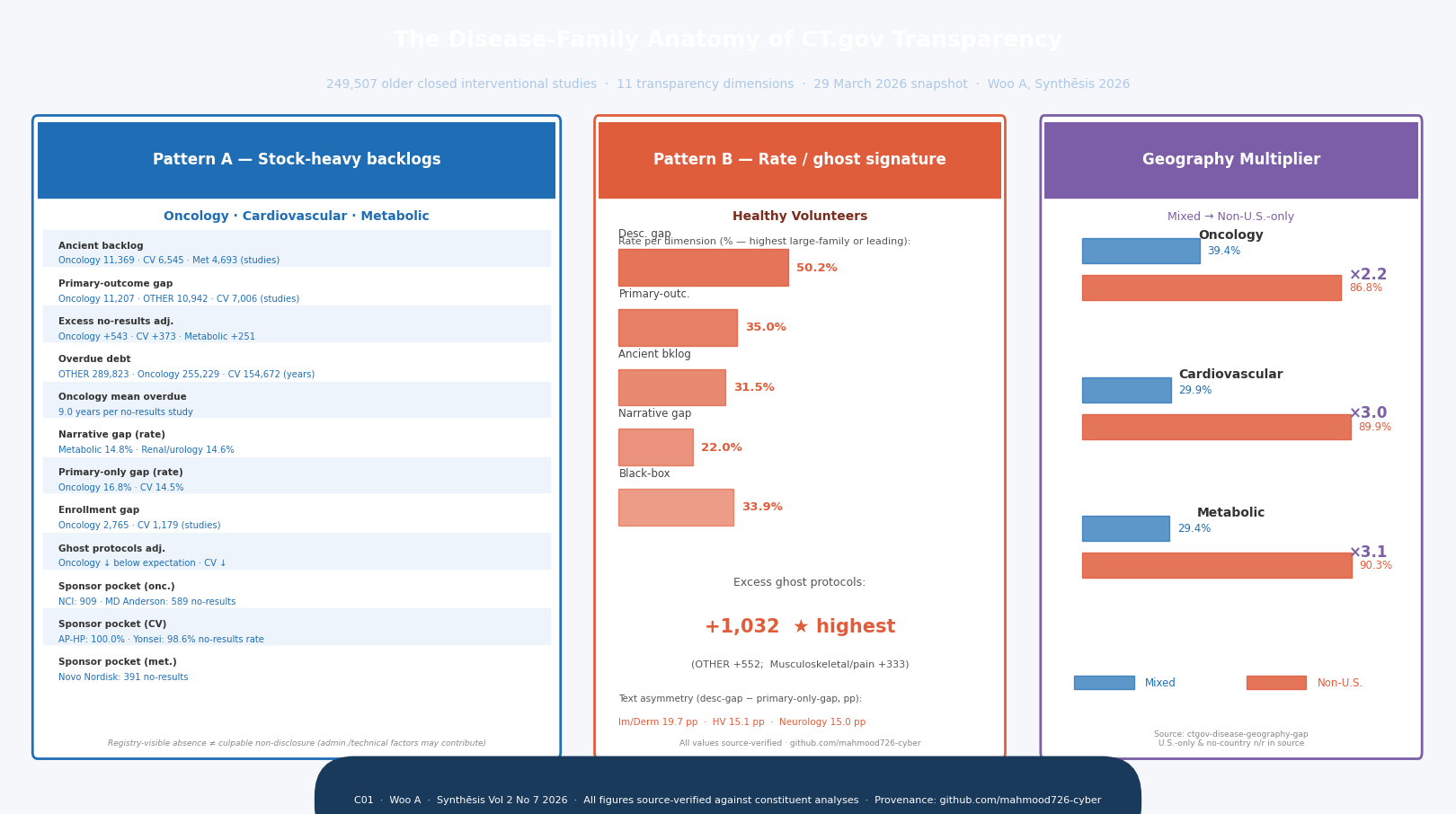
Published
2026-06-25
Issue
Section
Research Article
License
Copyright (c) 2026 The Author(s)

This work is licensed under a Creative Commons Attribution 4.0 International License.
Articles in Synthesis are published under the Creative Commons Attribution 4.0 International (CC BY 4.0) licence. Authors retain copyright.
How to Cite
The Disease-Family Anatomy of CT.gov Transparency: Eleven Condition-Stratified Dimensions across 249,507 Older Closed Interventional Studies. (2026). Synthesis, 2(7). https://synthesis-medicine.org/index.php/journal/article/view/173