The Anatomy of Hiddenness: A Multi-Axis Audit of Structural Non-Disclosure in ClinicalTrials.gov
Abstract
Systematic reviews increasingly use ClinicalTrials.gov as a core source for registered trials, but the completeness and linkage quality of the registry record are rarely incorporated formally into synthesis. A large number of registered studies never post results and never link to a publication. Using a single 29 March 2026 full-registry snapshot — 578,109 records, of which 441,191 were interventional and 290,524 were closed interventional — we used 249,507 eligible older closed interventional studies as the analytic core and audited structural non-disclosure along six axes. Two-year no-results rates ran from 67.0% in oncology to 76.2% in metabolic medicine. The missingness is structured: it tracks phase, architecture (one-arm 72.8% vs >=10-arm 55.3%), and outcome density (100% no-results when zero primary outcomes are recorded). Geographic footprint matters (single-site 79.5% vs >=20-site 31.7%), as does completion speed (same-year 85.7% vs 6-10-year lag 57.6%). Missingness is concentrated - the top 1% of lead sponsors hold 39.6% of the backlog (Gini 0.818). A strict NCT-indexed PubMed audit rescued only 1.2% of no-link studies; broadening to Europe PMC lifted weighted NCT-visible external-trace matching to 40.8%, indicating that a large fraction of apparent registry silence is an indexing-and-linkage gap rather than true absence. Hiddenness is a predictable, measurable property of the registry, and should be priced into downstream synthesis.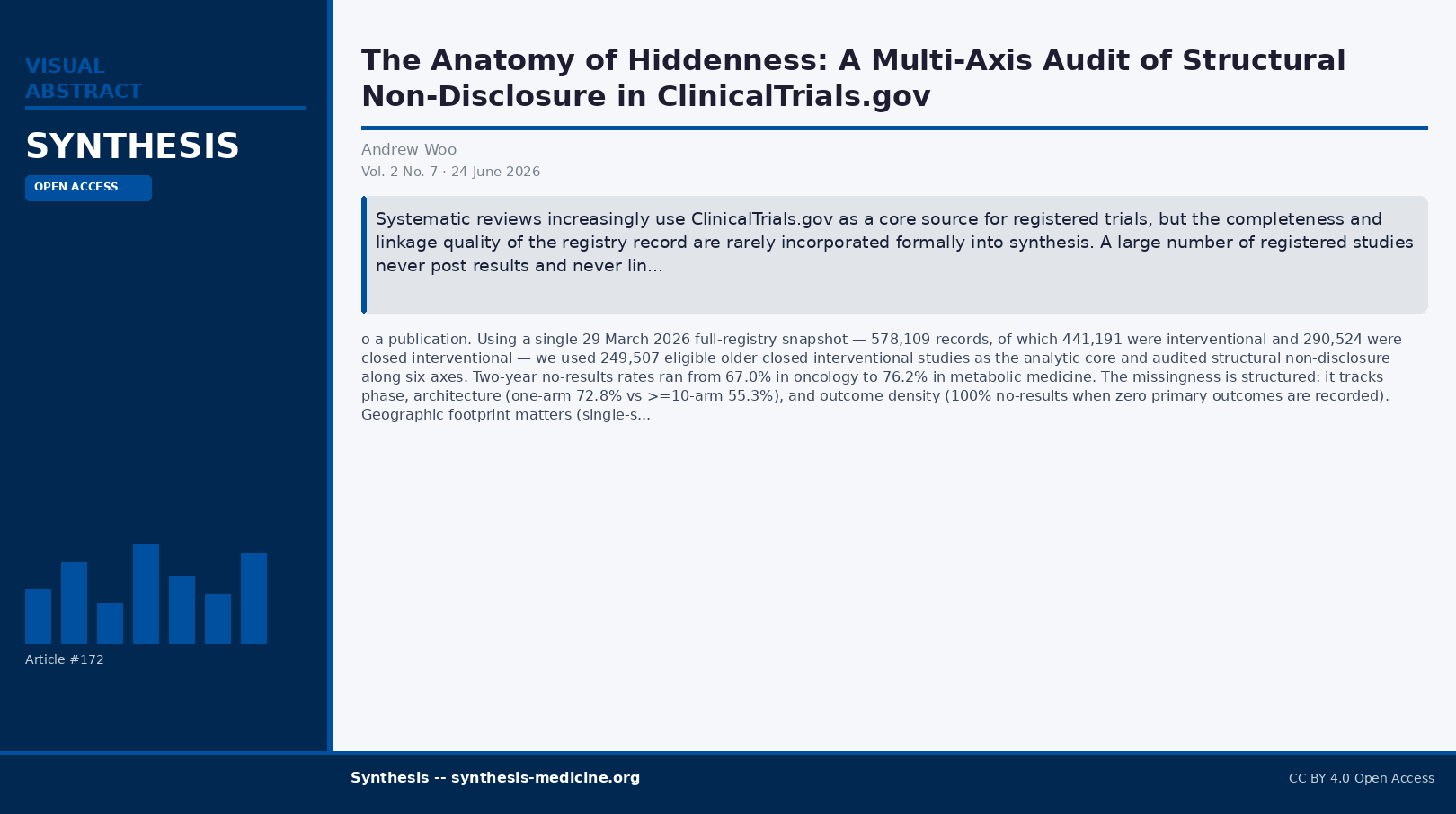
Published
2026-06-24 — Updated on 2026-06-25
Versions
- 2026-06-25 (3)
- 2026-06-25 (2)
- 2026-06-24 (1)
Issue
Section
Research Article
License
Copyright (c) 2026 Andrew Woo

This work is licensed under a Creative Commons Attribution 4.0 International License.
Articles in Synthesis are published under the Creative Commons Attribution 4.0 International (CC BY 4.0) licence. Authors retain copyright.
How to Cite
The Anatomy of Hiddenness: A Multi-Axis Audit of Structural Non-Disclosure in ClinicalTrials.gov. (2026). Synthesis, 2(7). https://synthesis-medicine.org/index.php/journal/article/view/172 (Original work published 2026)