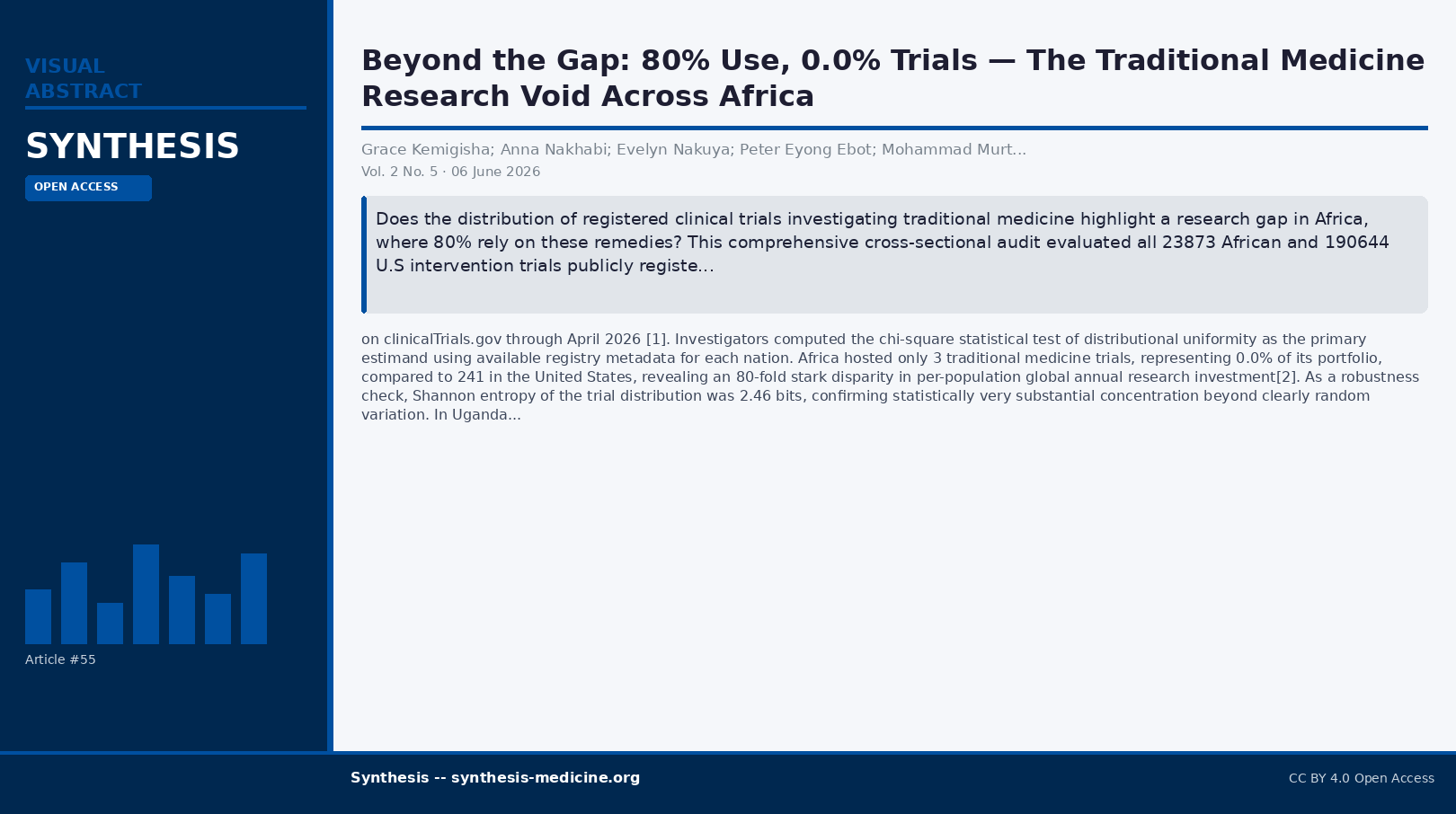
Beyond the Gap: 80% Use, 0.0% Trials — The Traditional Medicine Research Void Across Africa
Traditional Medicine Integration
Keywords:
Traditional Medicine, Beyond the Gap, Research VoidAbstract
Does the distribution of registered clinical trials investigating traditional medicine highlight a research gap in Africa, where 80% rely on these remedies? This comprehensive cross-sectional audit evaluated all 23873 African and 190644 U.S intervention trials publicly registered on clinicalTrials.gov through April 2026 [1]. Investigators computed the chi-square statistical test of distributional uniformity as the primary estimand using available registry metadata for each nation. Africa hosted only 3 traditional medicine trials, representing 0.0% of its portfolio, compared to 241 in the United States, revealing an 80-fold stark disparity in per-population global annual research investment[2]. As a robustness check, Shannon entropy of the trial distribution was 2.46 bits, confirming statistically very substantial concentration beyond clearly random variation. In Uganda, where traditional healers outnumber physicians 100 to 1, and herbs treat malaria and HIV, this trial gap fractures integrated care[3]. Missing subnational data and exclusion of registry-based observational studies also constrain generalizability and may significantly under-estimate actual traditional practice.
References
1. World Health Organization. (2023). WHO traditional medicine strategy: 2025–2034. Geneva: WHO.
2. Sundararajan, R., Ponticiello, M., Nansera, D., et al. (2024). Traditional healer support to improve HIV viral suppression in rural Uganda (Omuyambi): study protocol for a cluster randomized hybrid effectiveness-implementation trial. Trials, 25(1), 430. PMID: 38978123
3. Gang, R., Matsabisa, M., & Okello, D. (2024). Medicinal plants used for cutaneous wound healing in Uganda; ethnomedicinal reports and pharmacological evidences. Heliyon, 10(9), e29717.
Published
Versions
- 2026-06-16 (2)
- 2026-06-06 (1)
Issue
Section
License
Copyright (c) 2026 Grace Kemigisha, Ms Nakhabi, Ms Nakuya, Mr. Ebot, Mr Yusuf; Ms Nanono

This work is licensed under a Creative Commons Attribution 4.0 International License.
Articles in Synthesis are published under the Creative Commons Attribution 4.0 International (CC BY 4.0) licence. Authors retain copyright.