Research Sovereignty in African Clinical Trials: A Network Analysis of Global North and Global South Partnerships.
Keywords:
Clinical Trials, Research Sovereignty, Clinical Trials NetworksAbstract
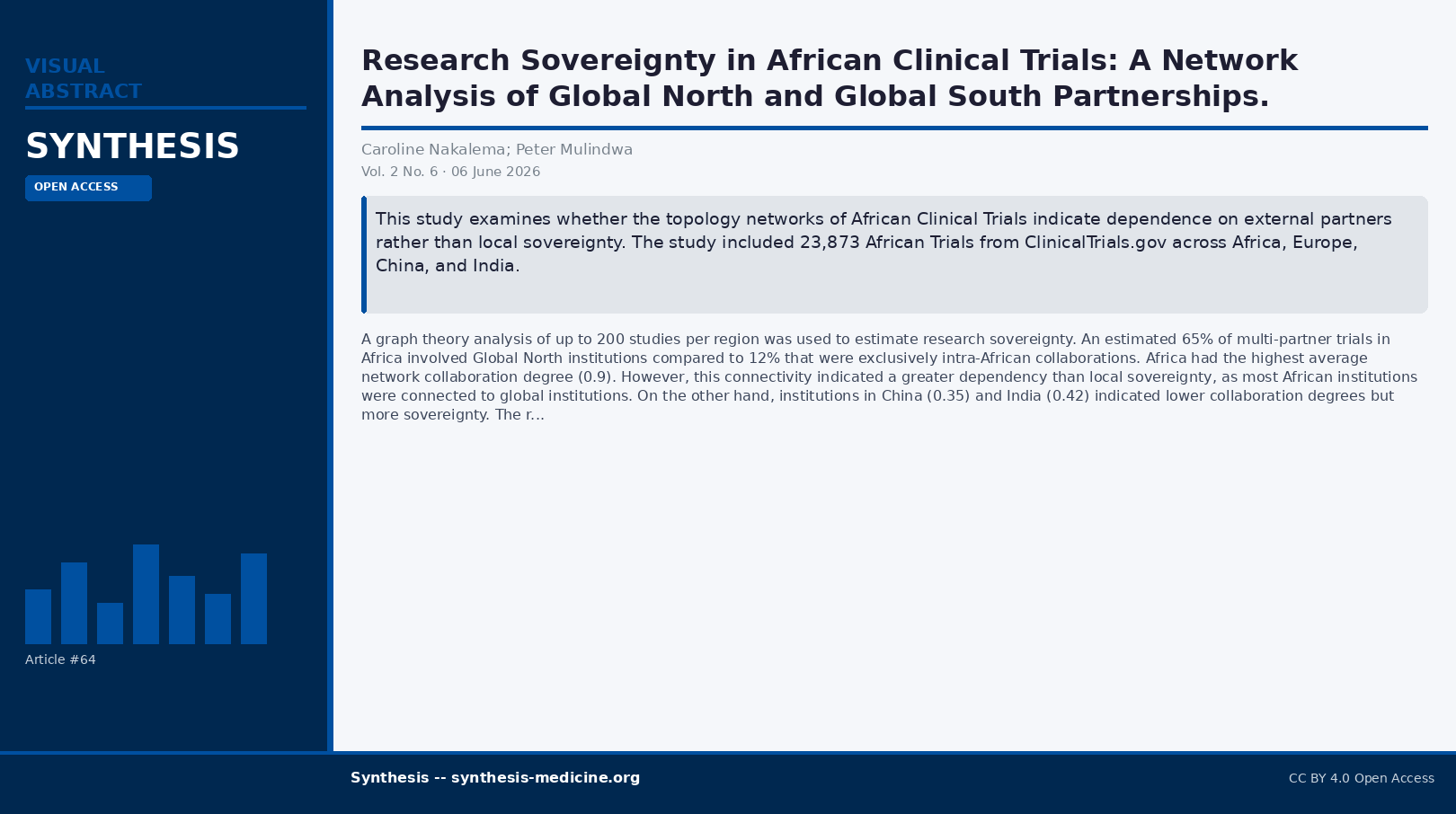
This study examines whether the topology networks of African Clinical Trials indicate dependence on external partners rather than local sovereignty. The study included 23,873 African Trials from ClinicalTrials.gov across Africa, Europe, China, and India. A graph theory analysis of up to 200 studies per region was used to estimate research sovereignty. An estimated 65% of multi-partner trials in Africa involved Global North institutions compared to 12% that were exclusively intra-African collaborations. Africa had the highest average network collaboration degree (0.9). However, this connectivity indicated a greater dependency than local sovereignty, as most African institutions were connected to global institutions. On the other hand, institutions in China (0.35) and India (0.42) indicated lower collaboration degrees but more sovereignty. The results indicate that while Africa is a major hub for clinical trials research, it lacks local governance and control over research. The data was limited by inference of collaborator origin based on institutional names.
References
Zannad F, Sobhy M, Almahmeed W, et al. Clinical research in Africa And Middle East: roadmap for reform and harmonisation of the regulatory framework and sustainable capacity development. Journal of Global Health Reports. 2019;3:e2019082. doi:10.29392/joghr.3.e2019082
Mugabe, J., et al., Securing Africa’s health sovereignty: Why investing in science and innovation matters. AAS Open Research, 2020.
Toure, K., E. Langlois, and D. Lakew, A new era for Africa's leadership: driving health sovereignty, financing, and equity. The Lancet Global Health, 2025. 13(10): p. e1661-e1662.
Published
Versions
- 2026-06-16 (2)
- 2026-06-06 (1)
Issue
Section
License
Copyright (c) 2026 Caroline Nakalema, Peter Mulindwa, Ahmad Mahmood

This work is licensed under a Creative Commons Attribution 4.0 International License.
Articles in Synthesis are published under the Creative Commons Attribution 4.0 International (CC BY 4.0) licence. Authors retain copyright.