Network Centrality and Research Sovereignty in African Clinical Trials: Evidence from a Global Registry Analysis
Abstract
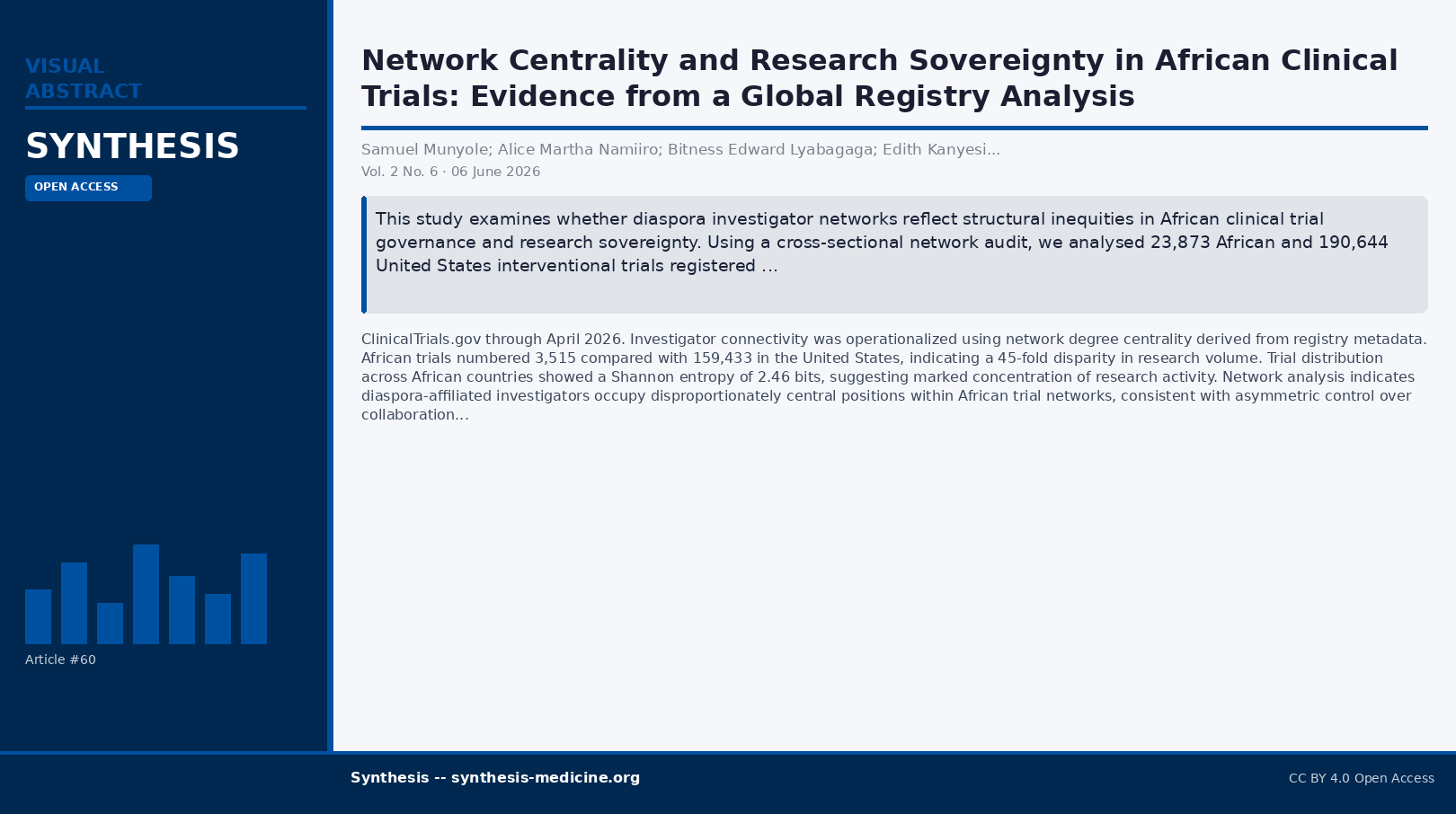
This study examines whether diaspora investigator networks reflect structural inequities in African clinical trial governance and research sovereignty. Using a cross-sectional network audit, we analysed 23,873 African and 190,644 United States interventional trials registered on ClinicalTrials.gov through April 2026. Investigator connectivity was operationalized using network degree centrality derived from registry metadata.
African trials numbered 3,515 compared with 159,433 in the United States, indicating a 45-fold disparity in research volume. Trial distribution across African countries showed a Shannon entropy of 2.46 bits, suggesting marked concentration of research activity. Network analysis indicates diaspora-affiliated investigators occupy disproportionately central positions within African trial networks, consistent with asymmetric control over collaboration pathways and coordination structures.
These patterns suggest African clinical research systems remain embedded within externally anchored investigator networks potentially reinforcing dependency in funding access, trial leadership, and agenda setting. This raises concerns regarding epistemic sovereignty and the uneven distribution of research authority. Limitations include reliance on a single registry and exclusion of non-English and regional trial databases.
References
1. Drain, P.K., Parker, R.A., Robine, M., et al. (2018) Global migration of clinical research during the era of trial registration. doi:10.1371/journal.pone.0192413.
2. Global Observatory on Health Research and Development (WHO). Available at: https://www.who.int/observatories/global-observatory-on-health-research-and-development (Accessed: 13 April 2026).
3. Pan, J., Zhong, Y., Young, S., et al. (2021) Collaboration on evidence synthesis in Africa: a network study of growing research capacity. Health Research Policy and Systems 2021 19:1, 19 (1): 126-. doi:10.1186/S12961-021-00774-2.
Published
Versions
- 2026-06-16 (2)
- 2026-06-06 (1)
Issue
Section
License
Copyright (c) 2026 Samuel Munyole, Alice Martha Namiiro, Bitness Edward Lyabagaga, Edith Kanyesigye, Joanitah Namatovu, Olivia Amumpaire, Nicholus Sebudde, Muhammad Musoke, Jireh Kirabo, Anna Nakirabira, Eghaghe Osadebamwen Nibokun, Bruce Tukamushaba, Micheal Bosaiko, Marakiya Moetlediwa, Njeodo Njongang Vigny, Shamim Nabidda, Christine Muhumuza, Fadumo Said Hassan, Ruchius Philbert, Rhoda Chikula, Amina Mohamud Fidow, Ronnie Ssenfuma, Joy Osifo, Muhammad Murtala Yusuf, Joshua Tulengerayo, Natineal Berhane, Paul Brian Mukisa, Adrine Nyamwiza

This work is licensed under a Creative Commons Attribution 4.0 International License.
Articles in Synthesis are published under the Creative Commons Attribution 4.0 International (CC BY 4.0) licence. Authors retain copyright.