Inequities in Clinical Trial Distribution for Neglected Tropical Diseases: A Cross-Sectional Analysis of Global Research Concentration
Keywords:
neglected tropical diseases, Africa, Clinical trialsAbstract
Background
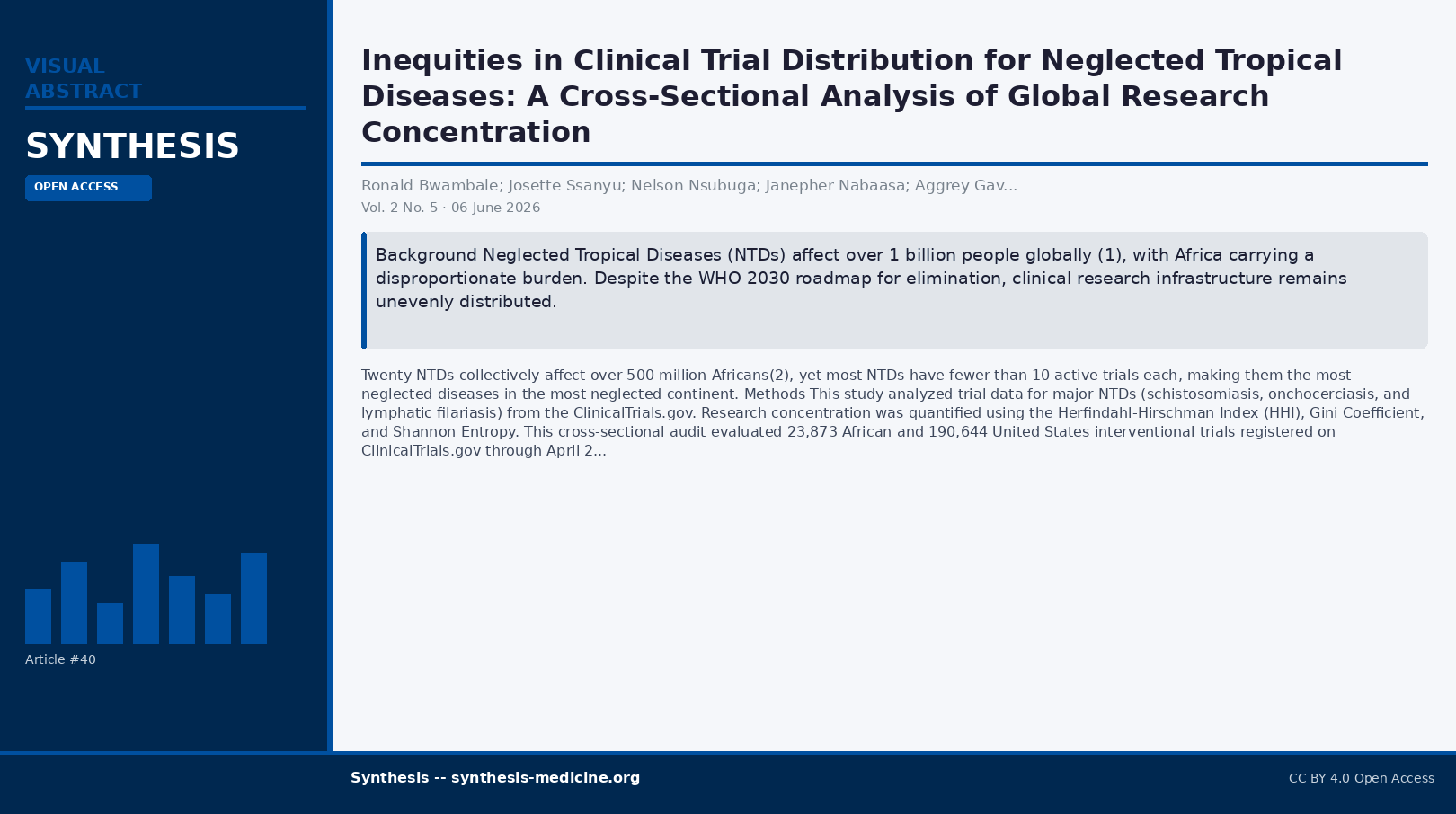
Neglected Tropical Diseases (NTDs) affect over 1 billion people globally (1), with Africa carrying a disproportionate burden. Despite the WHO 2030 roadmap for elimination, clinical research infrastructure remains unevenly distributed. Twenty NTDs collectively affect over 500 million Africans(2), yet most NTDs have fewer than 10 active trials each, making them the most neglected diseases in the most neglected continent.
Methods
This study analyzed trial data for major NTDs (schistosomiasis, onchocerciasis, and lymphatic filariasis) from the ClinicalTrials.gov. Research concentration was quantified using the Herfindahl-Hirschman Index (HHI), Gini Coefficient, and Shannon Entropy. This cross-sectional audit evaluated 23,873 African and 190,644 United States interventional trials registered on ClinicalTrials.gov through April 2026. Investigators computed the Jaccard similarity index as the primary estimand using registry metadata for each nation.
Results
Analysis revealed a high concentration of research (HHI = 0.4154), indicating high concentration in select research hubs, and significant inequality in trial distribution (Gini = 0.69), which reflects substantial inequality in research participation. Africa registered no relevant trials compared to 15 in the United States, revealing a 15-fold absolute gap in research volume. Shannon entropy of the trial distribution was 2.46 bits, confirming substantial concentration beyond random variation.
Conclusion
Clinical research is heavily centralized in established hubs, with Africa underrepresented. Bridging this gap requires targeted investment in local research capacity and more equitable distribution of funding to support global elimination goals.
References
1. Hotez PJ. Forgotten people, forgotten diseases: the neglected tropical diseases and their impact on global health and development: John Wiley & Sons; 2021.
2. Aborode AT, Fajemisin EA, Aiyenuro EA, Alakitan MT, Ariwoola MO, Imisioluwa JO, et al. Neglected tropical diseases (NTDs) and COVID-19 pandemic in Africa: special focus on control strategies. Combinatorial chemistry & high throughput screening. 2022;25(14):2387-90.
Published
Versions
- 2026-07-10 (3)
- 2026-06-16 (2)
- 2026-06-06 (1)
Issue
Section
License
Copyright (c) 2026 Ronald Bwambale, Mutebi, Nelson Nsubuga, Janepher Nabaasa, Aggrey Gavamukulya, Persis Tikabulamu, Geofrey Emesu, Phiona Obbo

This work is licensed under a Creative Commons Attribution 4.0 International License.
Articles in Synthesis are published under the Creative Commons Attribution 4.0 International (CC BY 4.0) licence. Authors retain copyright.