
OutcomeSwitchDetector: Automated Detection of Primary Outcome Switching in ClinicalTrials.gov Protocols
Abstract
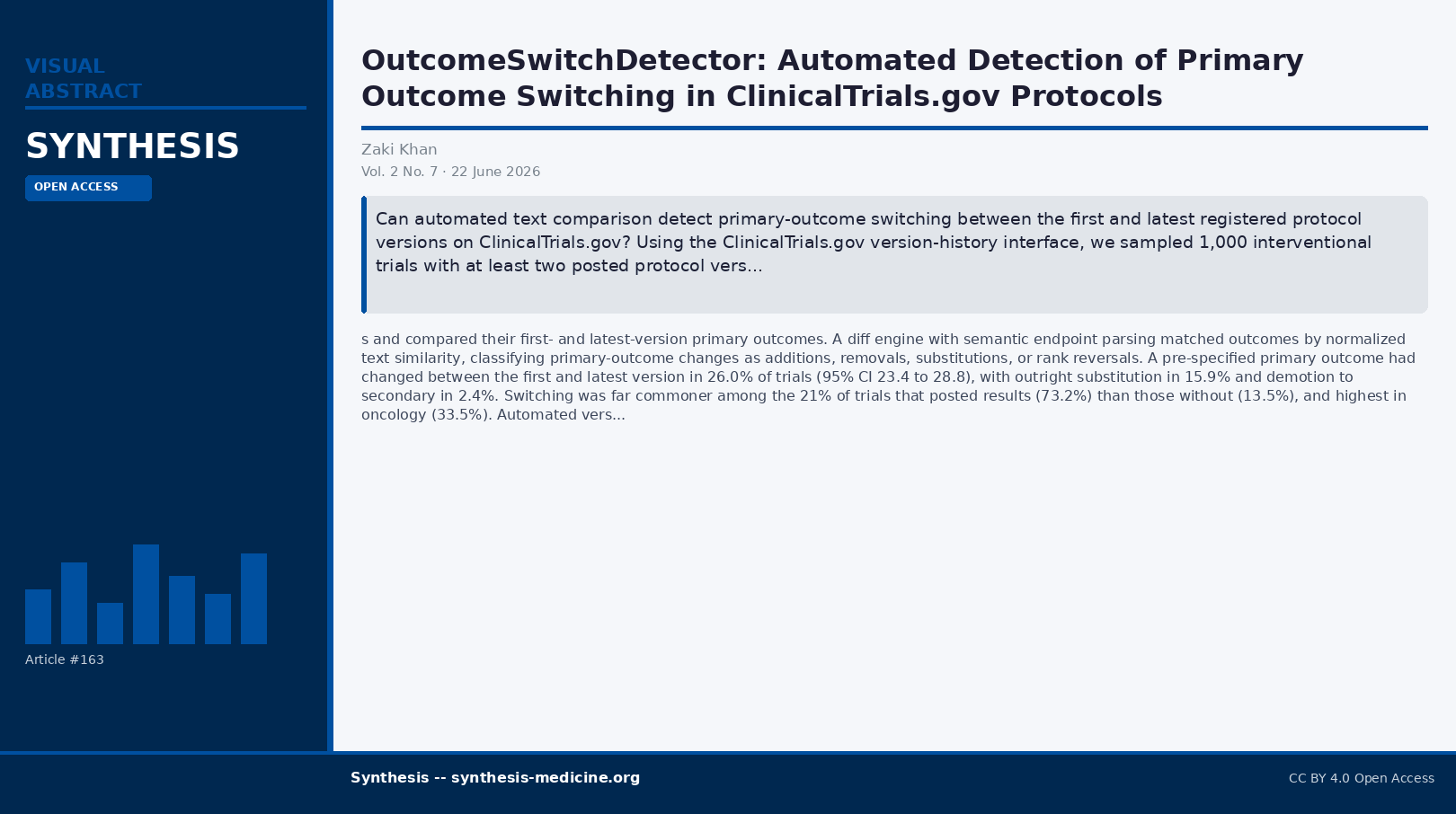
Can automated text comparison detect primary-outcome switching between the first and latest registered protocol versions on ClinicalTrials.gov? Using the ClinicalTrials.gov version-history interface, we sampled 1,000 interventional trials with at least two posted protocol versions and compared their first- and latest-version primary outcomes. A diff engine with semantic endpoint parsing matched outcomes by normalized text similarity, classifying primary-outcome changes as additions, removals, substitutions, or rank reversals. A pre-specified primary outcome had changed between the first and latest version in 26.0% of trials (95% CI 23.4 to 28.8), with outright substitution in 15.9% and demotion to secondary in 2.4%. Switching was far commoner among the 21% of trials that posted results (73.2%) than those without (13.5%), and highest in oncology (33.5%). Automated version-history screening therefore flags primary-outcome switching reproducibly and at scale, surfacing candidates for manual adjudication of clinical importance. Detection is limited to ClinicalTrials.gov structured outcome fields and to trials registering more than one protocol version.References
Zarin DA, Tse T, Williams RJ, Rajakannan T. Update on trial registration 11 years after the ICMJE policy was established. N Engl J Med. 2017;376(4):383-391. doi:10.1056/NEJMsr1601330
Anderson ML, Chiswell K, Peterson ED, Tasneem A, Topping J, Califf RM. Compliance with results reporting at ClinicalTrials.gov. N Engl J Med. 2015;372(11):1031-1039. doi:10.1056/NEJMsa1409364
Published
2026-06-22
Issue
Section
E156 Research Letter
License
Copyright (c) 2026 The Author(s)

This work is licensed under a Creative Commons Attribution 4.0 International License.
Articles in Synthesis are published under the Creative Commons Attribution 4.0 International (CC BY 4.0) licence. Authors retain copyright.
How to Cite
OutcomeSwitchDetector: Automated Detection of Primary Outcome Switching in ClinicalTrials.gov Protocols. (2026). Synthesis, 2(7). https://synthesis-medicine.org/index.php/journal/article/view/163