
CT.gov Completion Cohort Debt
Abstract
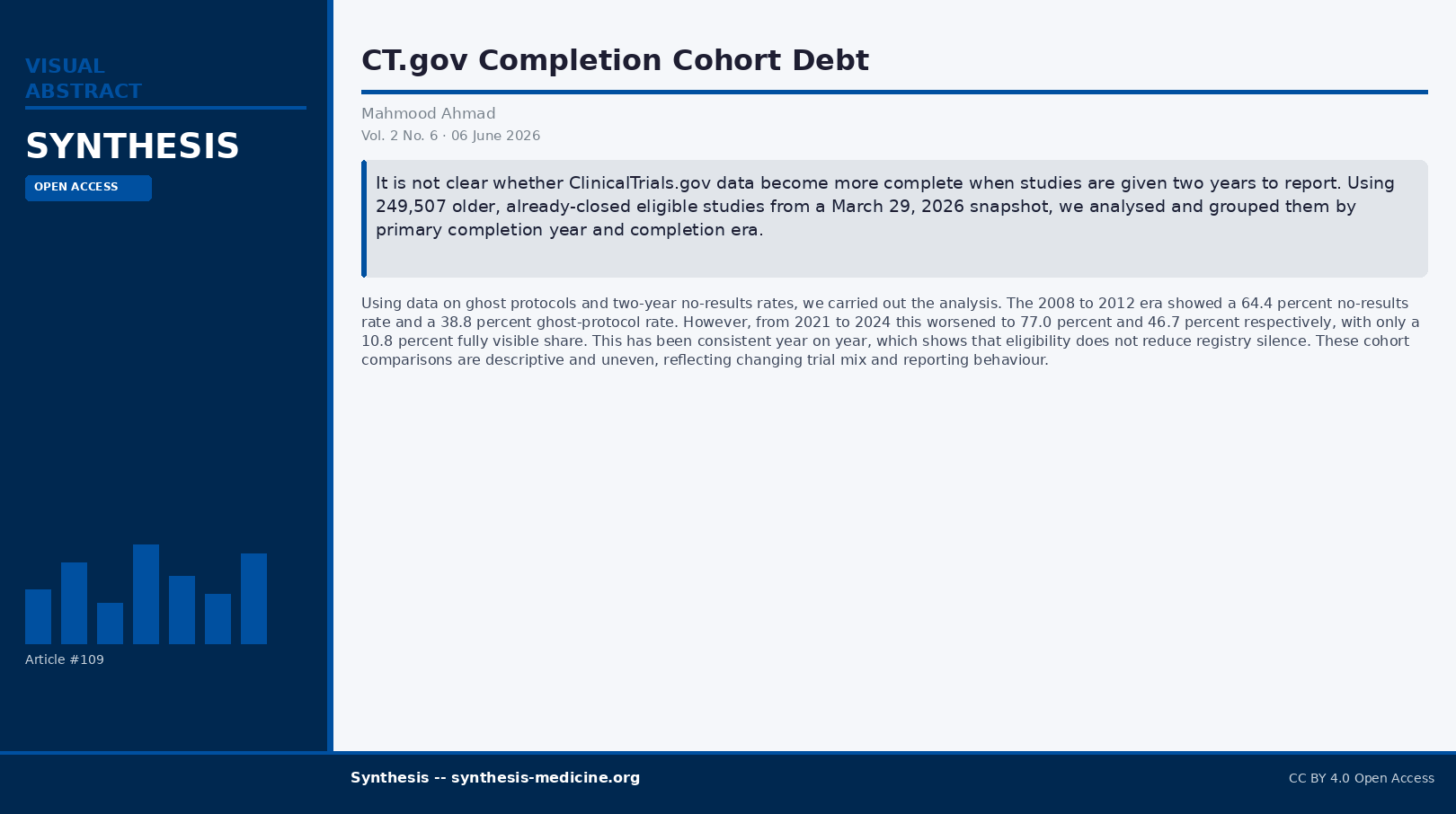
It is not clear whether ClinicalTrials.gov data become more complete when studies are given two years to report. Using 249,507 older, already-closed eligible studies from a March 29, 2026 snapshot, we analysed and grouped them by primary completion year and completion era. Using data on ghost protocols and two-year no-results rates, we carried out the analysis. The 2008 to 2012 era showed a 64.4 percent no-results rate and a 38.8 percent ghost-protocol rate. However, from 2021 to 2024 this worsened to 77.0 percent and 46.7 percent respectively, with only a 10.8 percent fully visible share. This has been consistent year on year, which shows that eligibility does not reduce registry silence. These cohort comparisons are descriptive and uneven, reflecting changing trial mix and reporting behaviour.
References
Zarin DA, Tse T, Williams RJ, et al. Update on Trial Registration 11 Years after the ICMJE Policy Was Established. N Engl J Med. 2017;376(4):. PMID 28121511.
Anderson ML, Chiswell K, Peterson ED, et al. Compliance with results reporting at ClinicalTrials.gov. N Engl J Med. 2015;372(11):. PMID 25760355.
National Library of Medicine. ClinicalTrials.gov API v2 [Internet]. Bethesda (MD): NLM; data snapshot accessed 29 March 2026. https://clinicaltrials.gov/data-api/api.
Page MJ, McKenzie JE, Bossuyt PM, et al. The PRISMA 2020 statement: an updated guideline for reporting systematic reviews. BMJ. 2021;372:n71. doi:10.1136/bmj.n71. PMID 33782057.
Borenstein M, Hedges LV, Higgins JPT, Rothstein HR. Introduction to Meta-Analysis. 2nd ed. Chichester: Wiley; 2021.
Downloads
Published
Versions
- 2026-06-16 (3)
- 2026-06-12 (2)
- 2026-06-06 (1)
Issue
Section
License
Copyright (c) 2026 Mahmood Ahmad

This work is licensed under a Creative Commons Attribution 4.0 International License.
Articles in Synthesis are published under the Creative Commons Attribution 4.0 International (CC BY 4.0) licence. Authors retain copyright.