Applying Placebo Ethics Audit findings to Uganda: Health System Challenges and Ethical Consideration in Clinical Trials
Abstract
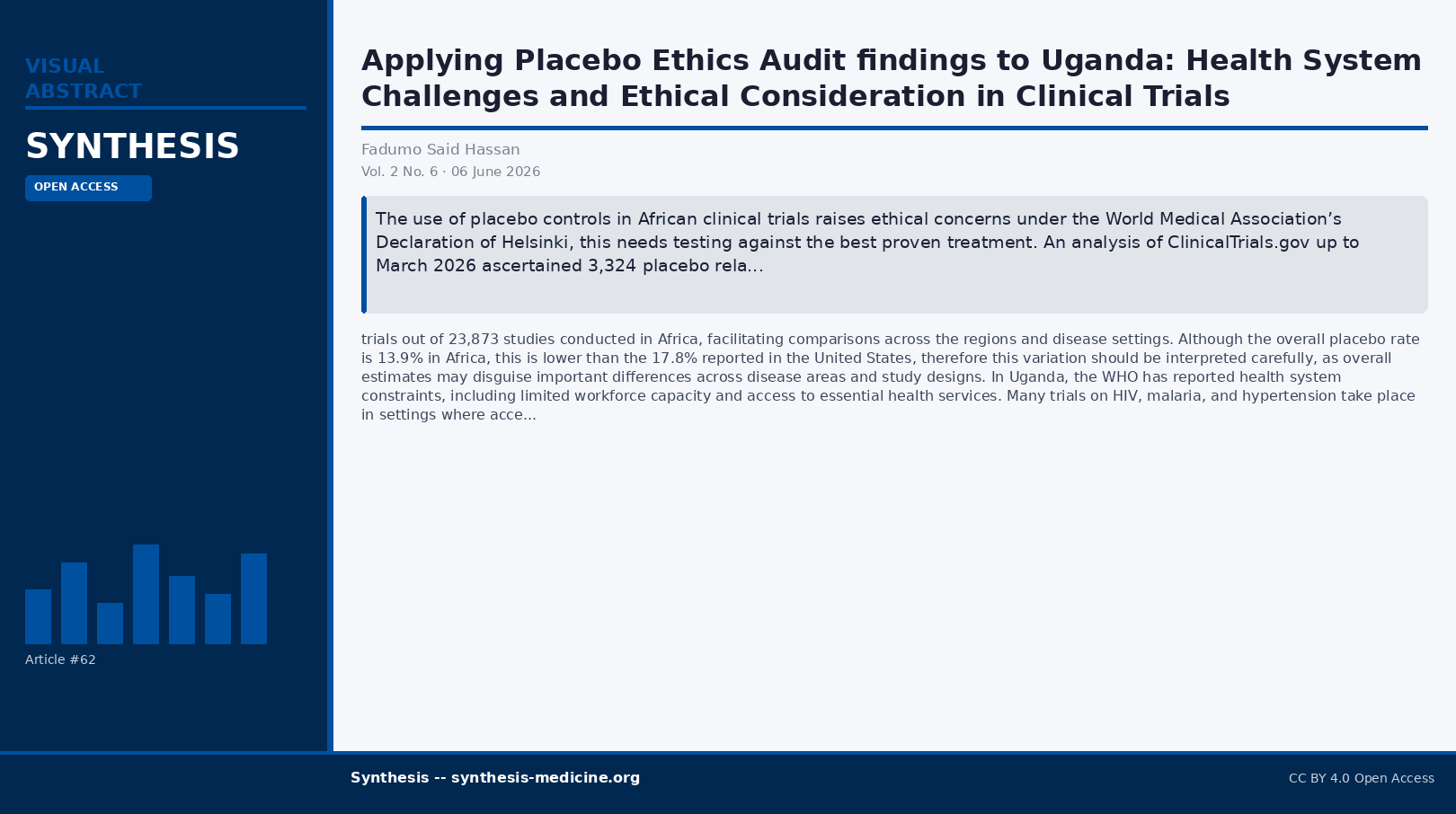
The use of placebo controls in African clinical trials raises ethical concerns under the World Medical Association’s Declaration of Helsinki, this needs testing against the best proven treatment. An analysis of ClinicalTrials.gov up to March 2026 ascertained 3,324 placebo related trials out of 23,873 studies conducted in Africa, facilitating comparisons across the regions and disease settings. Although the overall placebo rate is 13.9% in Africa, this is lower than the 17.8% reported in the United States, therefore this variation should be interpreted carefully, as overall estimates may disguise important differences across disease areas and study designs. In Uganda, the WHO has reported health system constraints, including limited workforce capacity and access to essential health services. Many trials on HIV, malaria, and hypertension take place in settings where access to consistent standard treatment may differ. These findings suggest that contextual factors, including health system capacity, may influence the appropriateness of placebo use, requiring cautious context specific interpretation further overall regional rates.
References
[1] W. M. Association, “World Medical Association Declaration of Helsinki: Ethical Principles for Medical Research Involving Human Subjects,” JAMA, vol. 310, no. 20, pp. 2191-2194, Nov. 2013, doi: 10.1001/jama.2013.281053.
[2] U.S. National Library of Medicine. ClinicalTrials.gov [database online]. Bethesda (MD): National Institutes of Health. Available at: https://clinicaltrials.gov. Accessed March 2026.
[3] World Health Organization (WHO), “WHO Uganda Annual Report 2022: Promoting Good Health and Wellbeing in Uganda.,” 2022. WHO AFRO; 2024.
Published
Versions
- 2026-06-16 (2)
- 2026-06-06 (1)
Issue
Section
License
Copyright (c) 2026 Fadumo Said Hassan

This work is licensed under a Creative Commons Attribution 4.0 International License.
Articles in Synthesis are published under the Creative Commons Attribution 4.0 International (CC BY 4.0) licence. Authors retain copyright.